Symbols For Our Liminal Times
From the earliest moments of human history, symbols have been how we make sense of the world. Before written language, before formal belief systems, before borders, humans marked meaning through shape, pattern, and form. These were not just decoration. They were communication, memory, and a way of saying, “this matters.”
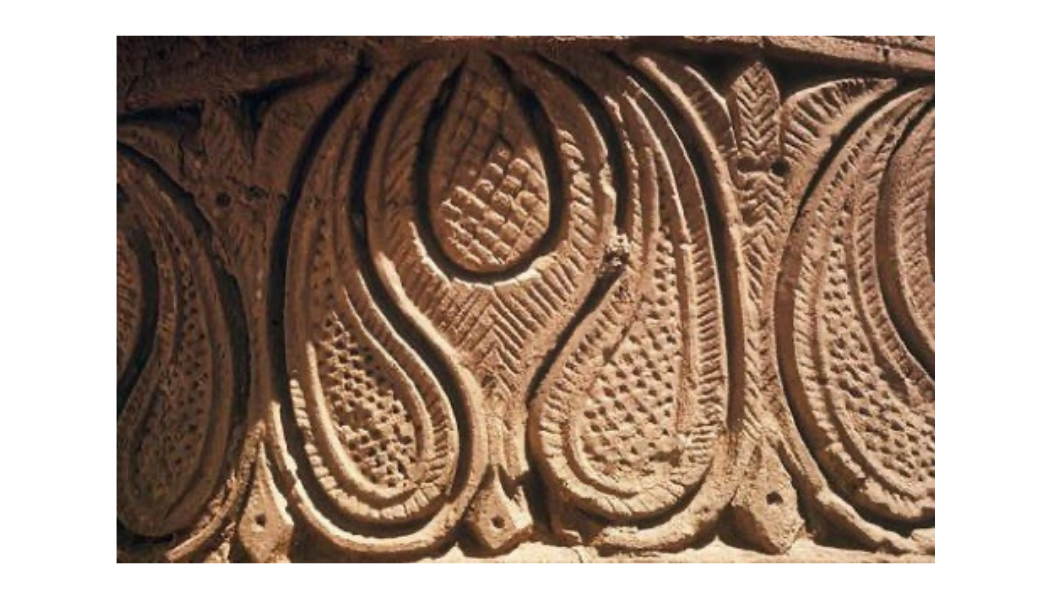
Botah Symbols, Noh Gunbad Masjid, early 8th century, Balkh, Afghanistan
When I first started designing pieces for Mazahri, I was drawn to ancient symbols and motifs that carried this same sense of universality, forms that held shared meaning while remaining rooted in my culture and heritage, originating in Afghanistan and greater Central Asia. At the time, my intention was to shed light on the meanings behind these motifs as a way of preserving a cultural language that was, and still is, at great risk of erasure.
Over the past couple of years, my relationship to these symbols has shifted. I find myself gravitating to them now not only as a way of preserving culture, but as a way of grounding myself and maintaining a sense of hope and meaning in our shared humanity and goodness, as each day seems to bring more upheaval in the world. In a way, these symbols have become even more universal and foundational for me.
During this first week of 2026, I am reflecting even more on the role of symbols in our shared understanding of ourselves. Traditionally, I have looked to the start of a new year as a fresh beginning, a moment that ushers in new energy and new cycles. But with the seemingly rapid pace of change and uncertainty in recent years, the last few new years have almost felt like false starts. Even now, only days into the year, I already feel overwhelmed by the state of the world. Symbols give me a way to stay oriented within that feeling, rather than lost inside it. Still, and perhaps because of this, I find comfort and a sense of grounding in our shared oneness, our humanity, and my belief that our collective sense of love is stronger than fear.
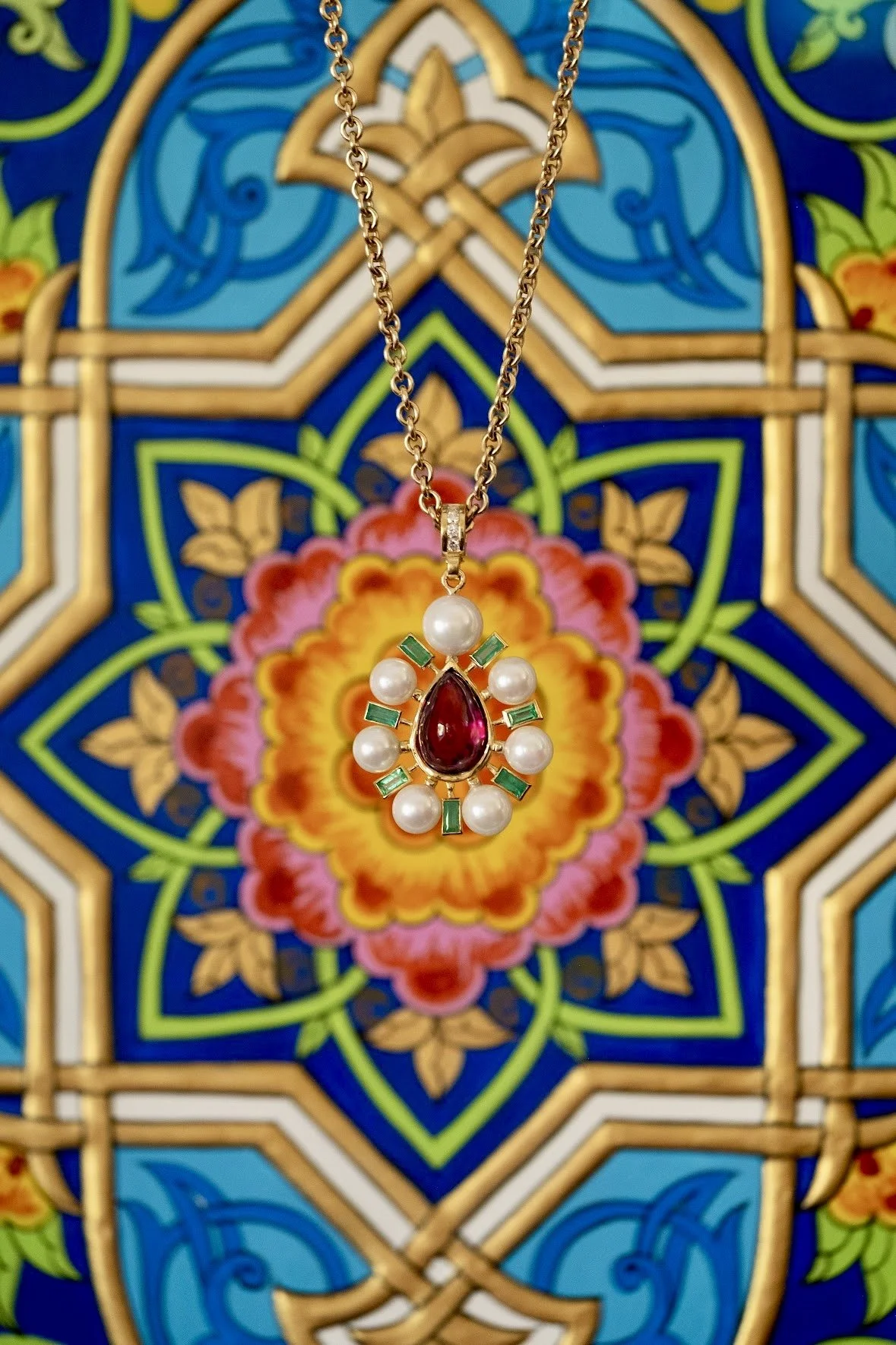
Mazahri Pearly Pear Cosmos celebrating our Oneness
Now, symbols feel less like references to the past and more like tools for orientation. They are not about nostalgia or decoration, but about remembering what matters when the ground feels unsteady. Long before written language or formal belief systems, humans used symbols to mark meaning, create continuity, and communicate shared values in moments of uncertainty and transition.
This is why we continue to return to them now. When familiar structures no longer offer reassurance and the future feels unclear, symbols become a quiet language we can still trust. They do not explain the world or resolve its complexity, but they help us remain connected to ourselves and to one another within it. In this way, symbols endure not because they belong to the past, but because they remain deeply necessary in the present.

Meanings Behind the Motifs
A brief introduction illuminating the meanings and significance behind the motifs and symbolism in Mazahri’s Tillya Tepe Collection.
Mazahri’s first collection is inspired by the Tillya Tepe excavation in Sheberghan, Afghanistan. Tillya Tepe translates to “Hill of Gold” in Uzbek, which aptly describes the trove of glittering artifacts from the first century C.E., revealing the rich cultural diversity of the Silk Road during the Bactrian era.

Human remains surrounded by gold and turquoise jewelry in a burial site at Tillya Tepe dating back to 1st century C.E.
Photo: Sputnik/Science Photo Library
The striking use of gold and stones including lapis lazuli, turquoise and carnelian to depict symbols including hearts, wheels, lotus blossoms, circles and geometric patterns weaves a stunning tapestry of the powerful stories, ideas, mythology, and religions permeating that time. These symbols depicting the abundance and diversity of ancient Afghanistan still resonate in modern times and can be observed in current embroidery, carpet weaving, jewelry motifs and even tattoos.
Below we describe some of the major themes behind the motifs in our first collection, illuminating the deeply significant meanings behind the designs.
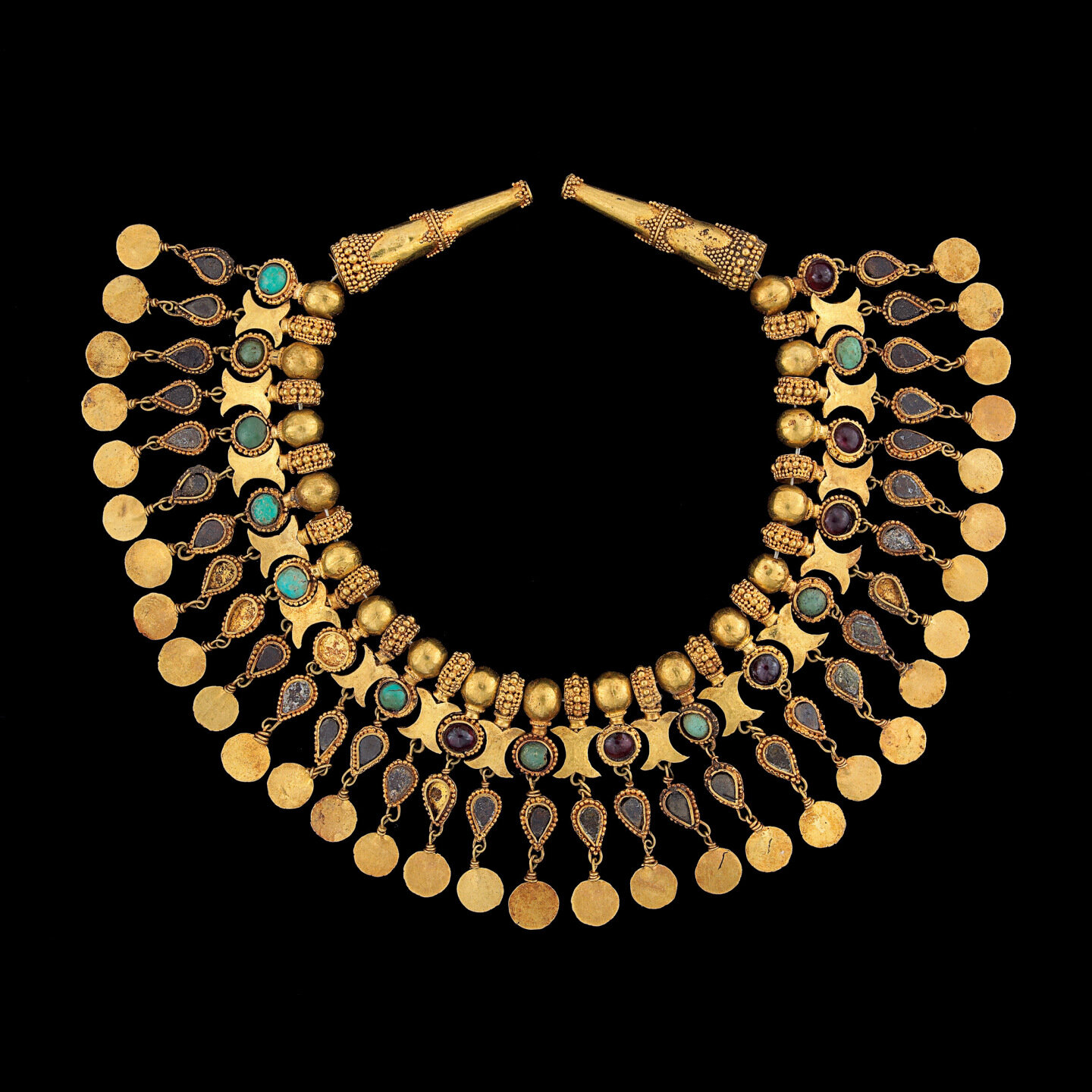
Ornament for the neck of a robe, Tillya Tepe, gold, turquoise, garnet, and pyrite. 1st century C.E.
Photo: Thierry Ollivier / National Geographic. Copyright Afghanistan Center at Kabul University
Zan/Rhombus
Zan means woman in Dari, the version of Farsi spoken in Afghanistan. Our Zan pieces are built around the rhombus shape, which has traditionally been used to represent women, creativity, and fertility in Afghan design. The rhombus is Mazahri’s signature symbol and we use it as a celebration of women and women’s empowerment. The rhombus shape is very significant in Afghan culture and is used widely in embroidery, carpet weaving, jewelry, and even traditional tattoos.

Mazahri Zan Dangle Earrings on hand embroidered dress yoke from Kabul, Afghanistan.

Image of Afghan woman with rhombus shaped face tattoos called Khaal.
Photo: Uncredited
Heart
The heart has long been associated with love and romance but the use of heart imagery in Bactria originated in people’s primal connection to nature. The heart shape used in Bactrian and Hellenic jewelry and embroidery is said to have been inspired by the heart shaped leaf of the ivy and similar plants. Relatedly, the word for love in Dari is Ishq with its etymology rooted in Ashaqa, an ivy plant that clings to the trees it grows around. Our fun and whimsical take on the ancient Bactrian heart motif is inspired by a pair of hoop earrings found in the Tillya Tepe excavation from the 1st century of the Common Era. Our use of two traditionally Afghan gemstone combinations, turquoise and ruby as well as lapis lazuli and emerald, pay homage to the influence of Afghan and greater Central Asian design in many of the classic jewelry combinations celebrated today.

Mazahri Tillya Tepe Heart Ring in lapis lazuli and emerald.

Gold hoop earrings with inlay turquoise hearts found at Tillya Tepe.
Photo: Source: Thierry Ollivier / National Geographic.
Lotus
The lotus flower, called nilofar in Dari, features prominently in Bactrian design illustrating the deep connection to many spiritual practices and religions practiced along the Silk Road. The Lotus has traditionally been used to represent rebirth, renewal, enlightenment and awareness in Buddhism, Hinduism, Zoroastrianism, and Islam which, have all been practiced in Afghanistan and greater Central Asia at different times. The continued importance of lotus symbolism is a testament to the diversity of religions, cultures, and the exchange of ideas and philosophies along the Silk Road, as well as the religious tolerance that has been a sacred tradition for the people of the region historically.

Turquoise and garnet inlayed lotus appliqués found at Tillya Tepe.

Mazahri Lotus Studs.
Circles and Orbs
Both our earthly sky and the heavens beyond have been great sources of inspiration for many world cultures and traditions including in ancient Afghanistan. The planetary orbits, prominence of the sun, the waxing and waning moons and morning star were particularly important symbols in the jewelry, embroidery, carpet weaving, and architecture of Bactria. These symbols evoke the deep spiritual connections we feel to the cosmos even now.

Mazahri Cosmos ring in turquoise and ruby.

Uzbek embroidery from Afghanistan.
The use of the sun, moon and star symbolism in our pieces is inspired in large part by the depiction of the sun, crescent moon and a morning star with multiple rays on a gilded ceremonial plate and multiple spherical pieces from 300 B.C.E found in the ancient Bactrian city of Aï Khanum, meaning Lady Moon in Uzbek, in Takhar, Afghanistan. Both the crescent moon and the star remain important in modern Afghanistan as the two together are often depicted as symbols of Islam.

A 3rd century B.C.E plaque shows Cybele and Nike, with iconography from Greece, Persia, and greater Asia. Found in Aï Khanum, Takhar, Afghanistan.
Photo: Thierry Ollivier / National Geographic

Mazahri Aï Khanum ring.
Through the Tillya Tepe Collection, Mazahri pays homage to these timeless motifs while raising awareness about their meanings and provenance.